
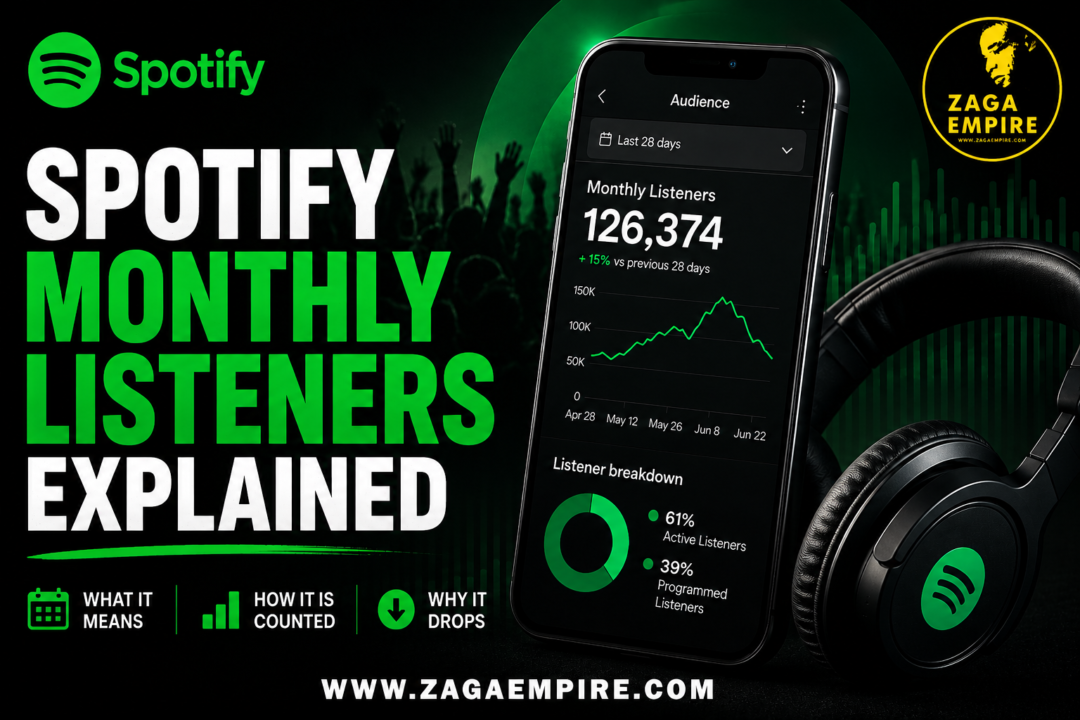
If you are an artist or you work in the music industry, you have probably heard people talk about Spotify Monthly Listeners. It is one of the most visible numbers on an artist’s Spotify profile and is often used to judge how well an artist or song is performing.
But what exactly does the number mean? How does Spotify calculate it, and why can an artist have 100,000 monthly listeners today and suddenly have fewer a few weeks later?
Here is how Spotify Monthly Listeners actually works.
What Are Spotify Monthly Listeners?
Spotify Monthly Listeners is the total number of unique listeners who have listened to an artist on Spotify within the last 28 days.
The important word here is unique.
If one person listens to your music once, that person can count as one listener. If the same person listens to your music several times within the period, they are still one unique listener, even though they may generate multiple streams.
Spotify confirms that Monthly Listeners includes people who listen from both active sources and programmed sources. Active listening includes intentionally choosing music from places such as an artist profile, release page or personal library, while programmed listening can come from sources such as editorial playlists, algorithmic playlists, Radio, Autoplay and playlists created by other listeners.
So, simply put:
Monthly Listeners = the number of different people listening to you.
Streams = the number of times your music is played.
Does Spotify Count Monthly Listeners for 30 Days?
No. Despite being called “Monthly Listeners,” Spotify does not calculate the number using a calendar month or a 30-day period.
Spotify uses a rolling 28-day window.
This means your monthly listener count today represents the unique people who listened to your music during the previous 28 days. Tomorrow, the calculation moves forward by one day.
For example, if 5,000 new people listened to your music on August 1, those listeners become part of your monthly listener count. Once August 1 falls outside the current 28-day window, people from that group who haven’t listened to you again within the newer window will no longer contribute to the current Monthly Listeners figure.
At the same time, new and returning listeners are constantly being added.
That is why the number can change regularly.
How Does Spotify Count a Listener?
Spotify defines listeners as unique people who stream your music during a specified period. Spotify also states that a song stream is counted when someone listens to the track for at least 30 seconds.
Spotify itself describes monthly listeners as listeners who have at least one qualifying stream of an artist during the past 28 days.
For example, imagine:
Listener A plays your song once.
Listener B plays it five times.
Listener C plays it 20 times.
You have reached three unique listeners, even though those people may have generated many more streams between them.
This is why an artist’s stream count and monthly listener count should never be treated as the same metric.
Why Do Spotify Monthly Listeners Drop?
This is where many artists become confused.
A drop in Spotify Monthly Listeners does not necessarily mean people have suddenly stopped listening to your music. In many cases, it is simply a result of the rolling 28-day calculation.
Imagine your song receives a major boost from a playlist, social media trend, new release campaign or collaboration and attracts thousands of new listeners within a few days.
Your Monthly Listeners will likely increase.
About four weeks later, those high-performing days begin falling outside the current 28-day window. If enough of those people haven’t listened to your music again, they are no longer included in the current figure.
If fewer new or returning listeners are entering the window than the number leaving it, your Monthly Listeners will drop.
Other factors can contribute to a decline as well. A song may lose significant playlist exposure, a viral moment may slow down, promotion around a release may end, or fewer new people may be discovering the music.
The key is understanding that Monthly Listeners is constantly moving. It is not an all-time audience figure.
Why Monthly Listeners Can Drop Even When You’re Still Getting Streams
An artist can continue receiving streams while their Monthly Listeners decline.
Suppose 10,000 people are regularly listening to an artist and repeatedly playing their songs. Those listeners can generate tens of thousands of streams without creating tens of thousands of new unique listeners.
This can result in strong streaming activity without a major increase in Monthly Listeners.
The opposite can also happen. A song could reach a huge number of unique listeners through a major playlist but receive relatively little repeat listening from many of them.
That artist may have impressive Monthly Listeners, but the number alone doesn’t tell you how engaged those listeners are.
Monthly Listeners vs. Monthly Active Listeners
Spotify also provides another useful metric inside Spotify for Artists: Monthly Active Listeners.
Monthly Listeners includes everyone who listened to the artist within the last 28 days from both active and programmed sources.
Monthly Active Listeners are the people who intentionally streamed the artist’s music from active sources during the last 28 days — for example, by visiting the artist’s profile or release page, or playing their music from their own library or playlists.
Spotify divides these active listeners into Light, Moderate and Super Listeners based on their level of intentional listening. Super Listeners, for example, are people who intentionally streamed an artist 15 or more times within the last 28 days.
For artists and their teams, this can provide more context than simply looking at the public Monthly Listeners figure because it helps show how many people are intentionally returning to the music.
Does Having More Monthly Listeners Mean an Artist Is Bigger?
Not always.
Monthly Listeners is a useful indication of an artist’s current reach on Spotify, but it should not be used alone to determine the strength of an artist’s career or fanbase.
A major playlist placement or viral record can expose an artist to a huge number of people and significantly increase Monthly Listeners. Another artist may have fewer Monthly Listeners but a stronger core audience that regularly returns to their catalogue.
Artists and their teams should therefore look at Monthly Listeners alongside other metrics such as streams, followers, saves, playlist activity and audience engagement.
Spotify itself encourages artists to look beyond surface-level numbers and use audience data to understand how listeners are developing into more engaged fans.
What Artists Should Take From Their Monthly Listeners
Growing your Monthly Listeners is good because it shows that more people are currently reaching your music. But keeping people interested after they discover you is even more important.
New releases, collaborations, playlists, marketing campaigns, social media and other forms of music discovery can bring new listeners in. The next challenge is giving those listeners a reason to come back, explore more songs, save your music and follow your artist profile.
So, if your Spotify Monthly Listeners drops after a release campaign or a major playlist moment, don’t immediately assume something has gone wrong.
Look at the bigger picture.
Monthly Listeners tells you how many people are currently reaching your music. What those listeners do afterwards can tell you much more about the audience you’re building.
Written by: GENERAL ZAGA
Discover more from
Subscribe to get the latest posts sent to your email.





No Comments